
Here is the business model Zillow has built around you: they aggregate buyer and seller demand, rank at the top of every relevant local real estate search, capture the lead, and sell it back to you — sometimes alongside two or three of your competitors — for a monthly fee that has nothing to do with whether the lead ever converts.
You already know this. Most agents who have bought Zillow Premier Agent leads know exactly what that relationship feels like. The question is what the alternative looks like and whether it’s realistic to build.
It is. Local SEO for real estate agents isn’t a magic pipeline that appears overnight, but it is a durable, owned source of buyer and seller leads that compounds over time and doesn’t send your prospects to four other agents simultaneously. This post is the practical playbook.
Why Real Estate Agents Are Particularly Vulnerable to Platform Dependency
Real estate is one of the industries most thoroughly colonized by aggregator platforms. Zillow, Realtor.com, Trulia, Redfin, and Homes.com collectively dominate the first page of Google for almost every home search query in the country. They have enormous domain authority, massive content libraries, and advertising budgets that individual agents and brokerages can’t match in head-to-head competition for those broad queries.
This creates a real constraint: you’re not going to outrank Zillow for “homes for sale in Palm Desert.” That’s not a realistic goal and it’s not what local SEO for real estate agents is actually about.
What local SEO is about is the searches the platforms don’t own as completely — the agent-specific, neighborhood-specific, and service-specific searches where an individual practitioner with a well-optimized local presence can compete and win. “Real estate agent Palm Desert,” “homes for sale La Quinta,” “best realtor Rancho Mirage,” “luxury real estate agent Coachella Valley” — these are the searches where your Google Business Profile, your website, and your content can compete directly and generate leads you don’t pay a per-inquiry fee for.
The Google Business Profile: Your Most Underused Asset
Most real estate agents either don’t have a Google Business Profile or have one they set up years ago and haven’t touched since. This is a significant missed opportunity.

Your GBP is what determines whether you appear in Google’s local pack — the map results that show at the top of the search results page when someone searches for a real estate agent in a specific area. That placement is worth more than most paid ad positions for service professional searches, and it’s driven almost entirely by how complete, active, and well-reviewed your profile is.
How to optimize it correctly
Category selection matters more than most agents realize. Your primary category should be “Real Estate Agent” or “Real Estate Agency” depending on your setup. If you specialize — luxury, commercial, land, investment — add relevant secondary categories. Getting the categories right is the first signal Google uses to understand what you do and where to show you.
Your service area definition should cover every city and community where you actively work. For a Coachella Valley agent that typically means Palm Desert, Palm Springs, Rancho Mirage, Indian Wells, La Quinta, Indio, Cathedral City, Desert Hot Springs, and possibly additional communities depending on your focus. Don’t list areas you don’t actually serve — Google can detect discrepancies between your stated service area and where your reviews and activity come from.
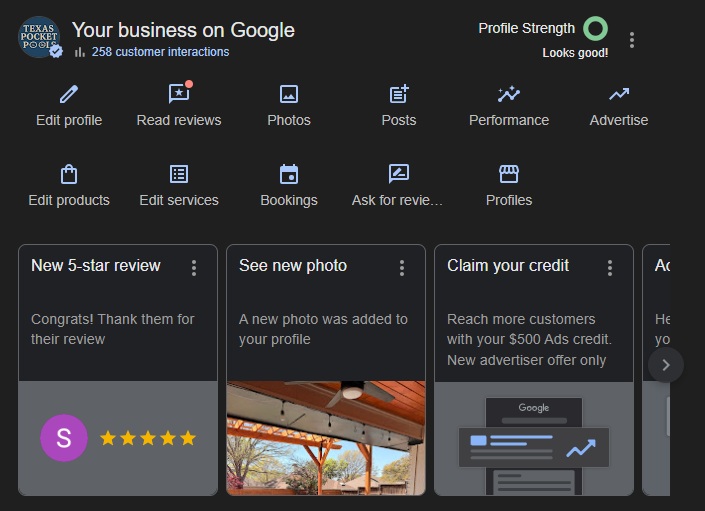
Photos need to be real and recent. Not stock photography, not your brokerage’s generic images — photos of you, photos of properties you’ve listed and sold, photos of neighborhoods you know. Google’s algorithm tracks engagement with profile photos, and profiles with authentic, frequently updated images consistently outperform those with static or stock imagery.
Posts to your GBP function like a social feed and signal to Google that the profile is active. A weekly post — a new listing, a recent sale, a market update, a neighborhood spotlight — takes five minutes and keeps your profile from going dormant. Dormant profiles lose ranking position over time.
The review strategy
Reviews are a local ranking signal, not just a reputation tool. Volume, recency, and quality all factor into where your profile appears relative to other agents in your area.
The most effective review strategy for a real estate agent is simple: ask every client at closing. Not via automated email three weeks later — in person, at the table, when the emotional high of completing a transaction is at its peak. A direct ask from an agent a client genuinely likes, at the moment of maximum goodwill, converts to a review at a dramatically higher rate than any automated follow-up sequence.
Respond to every review, including the negative ones. Google tracks response rate as a signal of active profile management, and the way you handle a critical review in public tells prospective clients more about your professionalism than a five-star average does.
Your Website: Built to Rank, Not Just to Exist
Most real estate agent websites are either generic brokerage templates or expensive custom builds that look impressive and generate no organic traffic. Neither extreme serves you well from an SEO standpoint.
What a real estate website needs to rank locally
Hyper-local page structure. The most effective real estate websites have individual pages for each community or neighborhood they serve — not just a single “areas served” page that lists ten cities in a paragraph. A dedicated page for Palm Desert real estate, a separate page for La Quinta homes, a page for Rancho Mirage luxury properties. Each page targets the specific search terms for that community and gives Google a clear, indexed signal about where you operate and what you offer.
These pages should include real content — market overview, neighborhood characteristics, school districts, price ranges, what makes the community distinctive — not just a search widget that pulls MLS listings. The MLS listings are fine to include, but they’re not what Google ranks on their own. The surrounding editorial content is what builds the page’s authority.
IDX integration that’s crawlable. Many IDX solutions load listing data in ways that search engines can’t index. If Google can’t crawl your listing pages, they contribute nothing to your organic presence. Make sure your IDX solution is configured for SEO — this is a technical detail worth verifying with whoever manages your site.
Title tags that include location. Your homepage title should not be your name alone. “Jane Smith, Palm Desert Real Estate Agent — Buying and Selling in the Coachella Valley” does significantly more SEO work than “Jane Smith Realty.” Every page title on your site should include a relevant location modifier.
Schema markup for real estate. LocalBusiness schema tells Google structured information about your practice — your name, address, service area, and contact information in a format search engines can read directly. RealEstateListing schema on your listing pages can trigger rich results in search. These are technical additions that don’t require significant ongoing effort but improve how your site communicates with search engines.
Content That Attracts Buyers and Sellers Before They’re Ready to Call
The most durable piece of a real estate agent’s local SEO strategy is content that answers the questions buyers and sellers are asking in the months before they actively engage an agent. Ninety percent of real estate clients research online before making contact with an agent. Content that shows up during that research phase builds familiarity and trust before you ever have a conversation.
Content types that work for real estate agents
Neighborhood and community guides. “Living in La Quinta: What to Know Before You Buy” or “The Palm Desert Real Estate Market: A Neighborhood-by-Neighborhood Guide” targets informational searches from buyers in the early stages of their search. These pages build organic traffic, establish your local expertise, and give you something genuinely useful to share with prospects you meet through other channels.
Market update content. Monthly or quarterly market reports for your specific area — median prices, days on market, inventory levels, year-over-year comparisons — are searched by both active buyers and curious homeowners tracking their equity. An agent who publishes consistent, accurate local market data becomes the source of record for that information in their market. That’s a positioning advantage that compounds over time.
Buyer and seller guides specific to your market. “How to Buy a Home in the Coachella Valley: What Out-of-State Buyers Need to Know” and “Selling Your Palm Desert Home: What Affects Your Sale Price in This Market” target high-intent searches from people in the active consideration phase. These aren’t people browsing — they’re people preparing to transact.
Seasonal and lifestyle content. The Coachella Valley has a unique market dynamic that most national real estate content ignores entirely. Content about the snowbird buying pattern, purchasing a second home in the desert, what it’s like to live in the Valley year-round versus seasonally, and how the festival season affects the local real estate market captures searches that no aggregator platform is targeting with any depth. That’s your lane.
The Citations Foundation (H2)
Local citation consistency — your name, address, and phone number appearing identically across every platform where you’re listed — is a foundational local SEO signal. For real estate agents this means:
Your brokerage website listing must show your direct contact information, not just the brokerage’s main number.
Realtor.com, Zillow, Trulia, and Homes.com profiles should be claimed and fully optimized with consistent contact information, even though these platforms also compete with you in search. Google sees your presence on these platforms as a signal of legitimacy.
Google Business Profile, Apple Maps, and Bing Places should all reflect identical business name, address, and phone number.
Local directories — the Coachella Valley Chamber of Commerce, Desert Business Network, local community websites — are worth pursuing both for citation consistency and for the occasional direct referral.
Run a citation audit once a year. Old phone numbers, previous addresses, and inconsistent business names erode Google’s confidence in your listing and suppress local rankings. The audit takes a few hours and is worth doing.
The Real Estate Agent SEO Timeline: What to Expect
Setting realistic expectations matters here because real estate agent SEO is not a 30-day project.
Months one and two are foundation work: GBP optimization, website technical audit and fixes, title tag and on-page corrections, citation cleanup, and the first community pages. You’re unlikely to see significant ranking movement yet, but you’re building the infrastructure that everything else runs on.
Months three through six are when content starts accumulating and rankings begin to move for lower-competition terms — your name, hyper-local neighborhood queries, long-tail buyer and seller searches. You may start to see your first organic leads during this window if the foundation work was done well.
Months six through twelve are when compounding starts to become visible. Pages that have been indexed for several months begin to gain authority, rankings improve on higher-competition terms, and the lead flow from organic search becomes more consistent. Agents who reach month twelve with a well-executed strategy typically have a meaningful organic lead channel that they didn’t have a year earlier.
This is a longer timeline than paid search, which is why the two channels complement each other — paid search for immediate lead flow while organic builds, organic for durable long-term presence that doesn’t disappear when you stop paying.
The Math on Zillow vs. Owned SEO
The financial case for building your own local SEO presence is straightforward.
Zillow Premier Agent in the Coachella Valley typically runs $500-1,500 per month depending on the zip codes you target and the level of competition. The leads you receive are shared with other agents, the conversion rate from lead to transaction is low (industry estimates put it at 1-3% for most markets), and you have no ownership of the relationship data — Zillow owns it.
A well-executed local SEO strategy for a real estate agent costs roughly the same amount per month when you factor in content creation, technical maintenance, and occasional link building. But the leads it generates are exclusive — they come directly to you, through your own site, searching specifically for what you offer. Conversion rates from organic search are consistently higher than from aggregator leads because the prospect chose to find you, not to be matched to you.
More importantly, SEO compounds. The content you publish today continues to generate traffic two years from now. The domain authority you build this year makes it easier to rank for competitive terms next year. A Zillow budget that stops generating the day you pause it cannot make that claim.
Where to Start
If you’re starting from zero, the priority order is: Google Business Profile first, on-page optimization second, community pages third, content fourth, citations and link building in parallel.
The GBP work takes a day and the impact can be visible within weeks for agents in markets where the local competition hasn’t fully optimized their own profiles. In the Coachella Valley, that’s most markets — there is meaningful white space available for agents willing to do the work consistently.
If you’d like a free assessment of your current local search presence — where you rank today, what your GBP looks like relative to competitors, and what the highest-leverage improvements would be — reach out. We work with real estate professionals across the Coachella Valley and understand the market dynamics that make this area different from every other real estate market in California.