Nobody starts a business because they love copying contact info from a web form into a spreadsheet. Or sending the same appointment reminder for the 400th time. Or chasing an invoice that should have been paid two weeks ago.
But that’s where a lot of small business owners spend their week. Not on sales, not on customers, not on the work they’re good at. On busywork that a computer could handle without ever getting bored or forgetting a step.
That’s the case for automation. And for most small businesses, it’s no longer a big-company luxury. Tools like n8n have made it affordable and flexible enough that a five-person team can run workflows that used to require a developer and a large software budget.
The Hidden Cost of Doing It All by Hand
Manual work doesn’t show up as a line item on your P&L, which is exactly why it’s easy to ignore. But it costs you in three ways.
- Every hour you or your staff spend on repetitive admin is an hour not spent selling, serving customers, or improving the business. Five hours a week adds up to more than 250 hours a year.
- Missed revenue. A lead that waits a day for a reply is a lead that called your competitor. Speed to response is one of the biggest factors in whether an inquiry turns into a customer, and humans juggling ten things are slow.
- People forget. They mistype an email address, skip a follow-up, or send the wrong attachment. Automated workflows do the same thing the same way every time.
Signs Your Business Is Ready for Automation
You don’t need a massive operation to benefit. If any of these sound familiar, you’re a good candidate:
- You copy and paste the same information between two or more apps.
- Leads from your website, ads, or Google Business Profile sit in an inbox until someone gets to them.
- You send the same emails or texts over and over with small changes.
- Follow-ups fall through the cracks when things get busy.
- Pulling together a weekly report means logging into five different dashboards.
- You’ve thought “there has to be a better way to do this” more than once this month.
What Automation Looks Like for a Small Business
Automation isn’t robots replacing your staff. It’s the boring, predictable parts of your day running in the background. A few common examples:
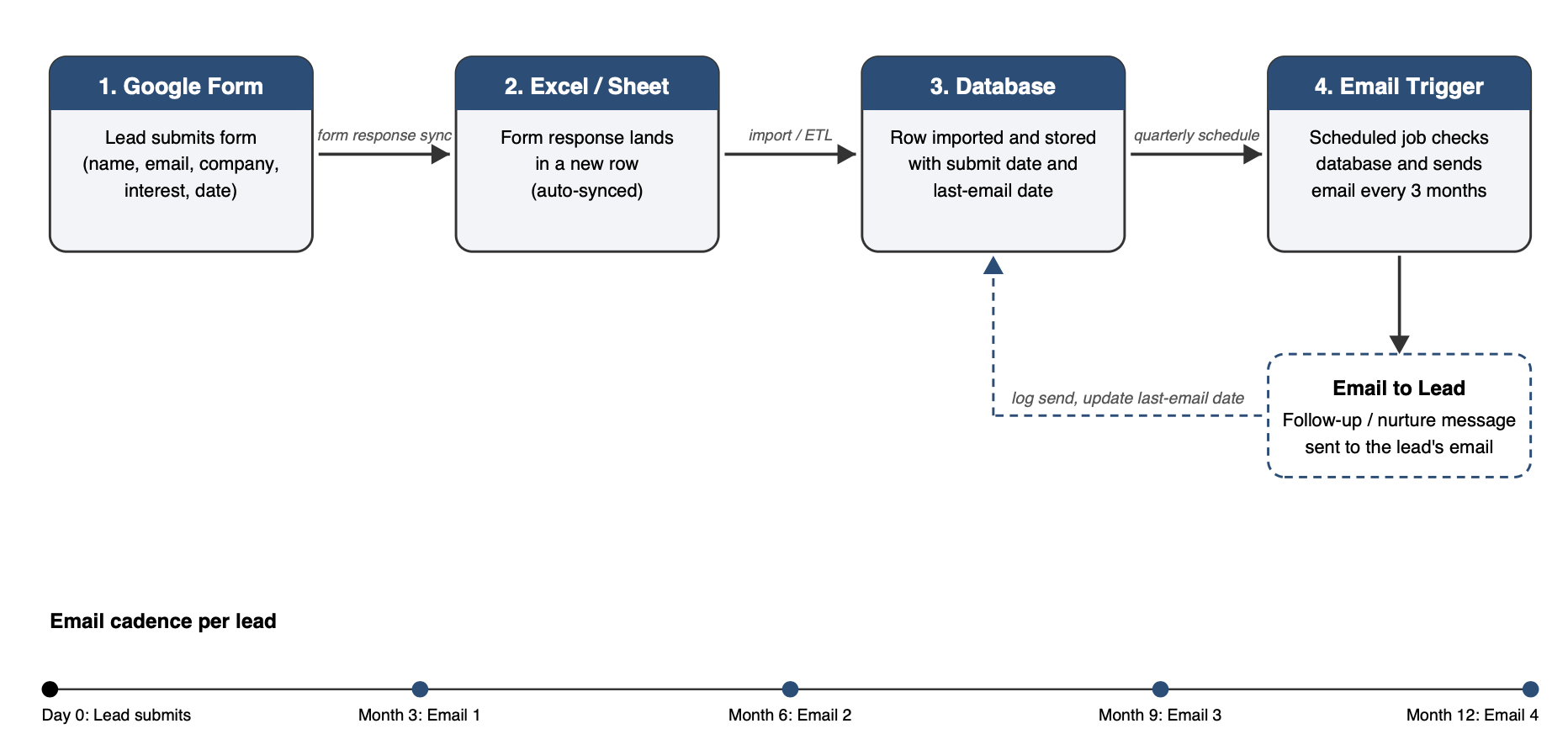
- Lead capture and follow-up. A new form submission lands in your CRM, your team gets a text or Slack alert, and the prospect gets a personalized reply within a minute. If they don’t respond in two days, a follow-up goes out automatically.
- Review requests. When a job is marked complete, the customer gets a thank-you message and a link to leave a Google review a day later.
- Appointment reminders. Confirmations, reminders, and reschedule links go out on their own, cutting down on no-shows.
- Invoice reminders. Overdue invoices trigger polite reminder emails on a schedule you set, so you’re not the one doing the chasing.
- Data from Google Ads, Google Analytics, and your CRM gets pulled into one sheet or email every Monday morning.
- Client onboarding. New customers get a welcome sequence, a kickoff checklist, and an internal task assigned to the right person.
Where n8n Comes In
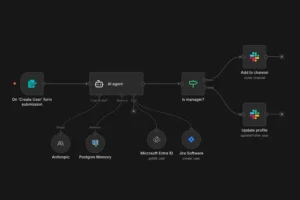
n8n (pronounced “n-eight-n”) is a workflow automation platform that connects your apps and moves data between them based on rules you set. You build workflows visually by linking nodes together, each one handling a step: a trigger, an action, a decision, a delay.
There are a lot of automation tools out there. Here’s why n8n is worth a serious look for small businesses:
- The price is hard to beat. n8n can be self-hosted for free, or you can use their cloud version, which starts at roughly $20 to $25 per month. That’s a fraction of what many businesses pay for software that does less.
- It doesn’t punish complex workflows. n8n charges by workflow run, not by individual step. A ten-step workflow that runs once counts as one execution. Other popular tools count every step separately, which means bills climb fast as your workflows get more sophisticated.
- It connects to the tools you already use. It has over 400 built-in integrations, including Google Workspace, HubSpot, Slack, Airtable, Stripe, and most major CRMs. If something isn’t on the list, it can connect to almost any app with an API.
- It handles real business logic. Branching logic, loops, wait steps, and conditions are all built in. You’re not stuck with simple “if this, then that” recipes.
- AI is built into the platform. n8n has native AI agent nodes that work with models like ChatGPT and Claude. That means a workflow can read an incoming email, figure out what the person wants, draft a reply, and route it to the right person for approval.
- You keep control of your data. Because n8n can run on your own server, sensitive customer data doesn’t have to pass through a third-party platform. For healthcare, legal, and financial businesses, that matters.
n8n vs. Zapier and Make
Zapier is the name most people know, and it’s the easiest for total beginners. It also has the largest app library. Make sits in the middle, with a visual builder and a solid integration catalog.
The tradeoff is cost and flexibility. Zapier and Make both bill based on individual steps or operations, so a busy multi-step workflow can get expensive quickly. n8n has a steeper learning curve, but once a workflow is built, it typically costs far less to run at volume, and it gives you more room to build exactly what you need.
For a business with one or two simple automations, Zapier is fine. For a business that wants automation to run a real part of its operations, n8n is usually the better long-term choice.
A Simple First Workflow
Here’s an example of a lead-response workflow many service businesses could set up in an afternoon:
- A prospect fills out the contact form on your website.
- n8n adds them to your CRM and tags the lead source.
- Your team gets an instant text or Slack message with the lead’s details.
- The prospect receives a personalized email confirming you got their request and when to expect a call.
- If nobody on your team marks the lead as contacted within 24 hours, the owner gets a reminder.
No more leads buried in an inbox. No more “I thought you called them.” That one workflow alone can pay for itself with a single extra closed deal.
What to Watch Out For
Automation is powerful, but it’s not magic. A few things to keep in mind:
- Don’t automate a broken process. If a process is messy when done by hand, automating it just makes the mess happen faster. Map out how the process should work first.
- Assign an owner. Workflows need someone who knows how they work and checks on them. When an app updates its connection or a password changes, things can stop running quietly.
- Be realistic about self-hosting. Self-hosting n8n is free, but it means someone has to handle the server, updates, and backups. If that’s not you, the cloud version or a managed setup is the smarter path.
- Keep a human in the loop for AI. AI can draft replies and sort requests well, but anything customer-facing should have a human approval step until you trust the output.
How to Get Started
Start small. Pick the single most annoying, repetitive task in your week, the one you’d hand off in a heartbeat if you could. Write down every step. Then build one workflow that handles it. Measure the time saved, fix what doesn’t work, and move on to the next one.
Most businesses find that after three or four workflows, automation stops feeling like a project and starts feeling like an extra team member who never calls in sick.
Need Help Building It?
Lionwish designs and builds n8n workflows and AI agents for small businesses, from lead follow-up and review requests to reporting and client onboarding. We’ll look at where your team is losing time, identify the workflows with the fastest payoff, and build them so they run in the background while you focus on growing the business.
Reach out to Lionwish to talk through what automation could take off your plate.